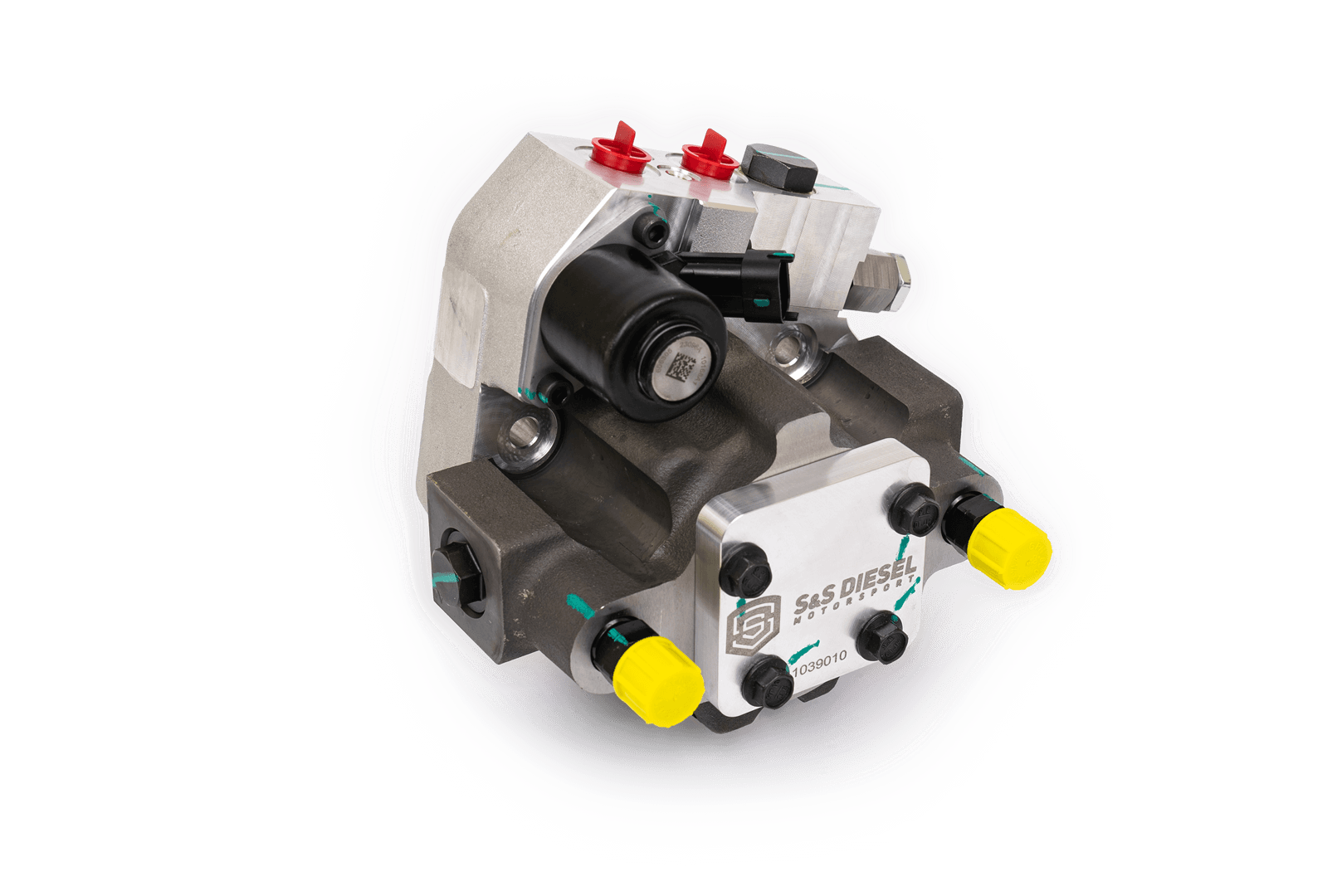
A DCR pump is a Stanadyne-designed high-pressure fuel pump; DCR stands for Diesel Common Rail, and it replaces the failure-prone Bosch CP4.2 in 2011–2025 6.7L Power Stroke trucks. Co-developed by S&S Diesel Motorsport and PurePower Technologies, the conversion is a true drop-in: no tuning, about 25% more fuel delivery than the CP4, and CARB-legal in all 50 states.
If the disaster prevention kit contains the damage from a CP4 failure, the DCR conversion removes the CP4 and replaces it with a different pump design. Here’s what the pump actually is, where it comes from, and why it doesn’t have the CP4’s problem.
Quick Facts
| Fits | 2011–2025 Ford F-250 through F-750, 6.7L Power Stroke |
| Price | $2,400 (part #6.7F-DCR-1) |
| Tuning required | None, the pump matches the CP4’s output curve, so the stock ECU never knows the difference |
| Fuel delivery | 1,250 mm³ per revolution, roughly 25% more than a CP4.2 |
| Emissions | CARB EO D-756-7, legal in all 50 states |
| The pump | Stanadyne two-piston DCR, winner of a 2024 Automotive News PACE Award |
| Built | USA, by PurePower Technologies (a Stanadyne company) |
Where the DCR Pump Comes From
The DCR isn’t a Bosch product, and it isn’t a Denso product; that’s the first thing to get straight, because plenty of people mix it up. It’s a Stanadyne design. Stanadyne is an American fuel-injection manufacturer that’s been building diesel injection equipment since the late 1940s, and if you’ve ever run an older mechanically injected diesel, odds are decent it had Stanadyne hardware on it.
The DCR, Diesel Common Rail, is their modern two-piston high-pressure pump family, built around a patented eccentric-drive pumping design and used in OE applications around the world. The two-piston DCR is designed to be compatible with biofuel blends and low-lubricity diesel. In 2024, the two-piston DCR won an Automotive News PACE Award, an OE-industry innovation award, not an aftermarket trophy.
For the Ford application, S&S Diesel Motorsport teamed up with PurePower Technologies, Stanadyne’s aftermarket division, to adapt that pump to the 6.7L Power Stroke. The joint engineering team developed a variant with an S&S-designed pump cam and metering setup specifically so it would bolt in where the CP4 lives and behave, from the ECU’s perspective, exactly like the pump it replaces.
Why the DCR Conversion Exists: The CP4 Problem
Quick recap if you’re new to this mess. The Bosch CP4.2 in every 2011+ 6.7L Power Stroke has a known failure mode: its roller lifters can rotate on the cam lobe, and instead of rolling, they skate and grind. Low-lubricity US diesel gives the pump less protection than the design assumed. When it fails, it fails without warning, and it pushes metal debris through the entire fuel system at injection pressure. S&S puts the resulting repair bill at $10,000 to $15,000, and that squares with what owners see at the dealer.
There are two ways to deal with that. You can contain the failure with a $400 disaster prevention kit and keep the stock pump, or you can remove the failure point from the truck entirely. The DCR conversion is the second path.
How the DCR Fixes What the CP4 Got Wrong
This is the part that matters, because the DCR isn’t just “a different pump”; its architecture designs out the CP4’s specific failure mode.
The drive system. The CP4 dies at the roller-to-cam interface, a metal-on-metal contact point that depends heavily on the fuel itself for lubrication. The DCR uses Stanadyne’s patented eccentric-drive pumping operation with a pressure-lubricated cam and bushings. The exact spot where the CP4 grinds itself into glitter simply doesn’t exist in this design.
The fuel tolerance. The DCR is engineered from the ground up for biofuel blends and low-lubricity diesel, the fuel that’s actually in American pumps, not the fuel the CP4 was originally designed around in Europe. That’s not a coating or a band-aid; it’s the design brief.
The metering valve. The fuel control actuator uses corrosion-resistant components with features that keep larger debris out of the actuator, one of the CP4’s known vulnerability points, and the first place you see glitter on a failing pump.
The manners. Low hydraulic and acoustic noise, fast response. It behaves like original equipment because that’s the standard it was built to.
What “Plug-and-Play” Actually Means Here
“No tune required” gets thrown around loosely in the diesel world, so here’s what it means in this case: the S&S/PurePower team matched the DCR’s output curve to the CP4’s. The factory ECU commands rail pressure exactly like it always has, and the pump delivers it. No calibration changes, no flashing, no handheld tuner, no emissions gray area, which is how the kit carries CARB EO D-756-7 and stays legal in all 50 states.
The kit ships with OE-grade fuel-rated hose and steel fuel lines, factory-style connectors, and everything needed to install it in place of the CP4. One kit covers 2011–2025. One install note worth knowing up front: 2011–2016 trucks disturb a one-time-use vacuum pump gasket during the job (MAHLE B32630), so have one on hand before you start.
Access is the same as any work on this pump; the CP4 lives under the intake, so the intake comes off. It’s a job for a competent DIYer with hand tools and a clean workspace, or any diesel shop.
More Delivery, More Margin
The DCR delivers 1,250 mm³ per revolution, about 25% more than the CP4.2’s roughly 1,000 mm³. That additional delivery covers worn injectors with high return rates. It gives the fuel system breathing room the CP4 never had.
The DCR wasn’t designed as a race pump, but the extra displacement means it doesn’t tap out where a stock CP4 does. Delivery lands in the same neighborhood as a 10mm stroker CP4, and customers regularly report 700 to 800 wheel horsepower on a single DCR.
When a build outgrows a single pump, the move isn’t to replace the DCR. It’s to add to it. A DCR in the valley with a secondary belt-drive CP3 is a proven high-horsepower combination, and it’s proven for a reason: the valley pump keeps making rail pressure no matter what the belt is doing. That’s the setup behind multiple 1,000-plus horsepower race and pulling trucks running today.
DCR vs. CP4 at a Glance
| Bosch CP4.2 (stock) | Stanadyne DCR | |
| Drive design | Roller lifters on cam, the known failure point | Patented eccentric drive |
| Cam lubrication | Fuel-lubricated roller-to-cam interface | Pressure-lubricated cam and bushings |
| Low-lubricity US fuel | A contributing cause of failures | Designed for it, biofuel compatible |
| Max delivery | ~1,000 mm³/rev | 1,250 mm³/rev (+25%) |
| Failure reputation | Well-earned, fails without warning | OE-grade durability record, PACE Award-winning design |
| Tuning to install | None |
What It Costs, and the Math
The conversion is $2,400. A CP4 failure is $10,000 to $15,000. That’s the whole equation, but there are two ways to time it:
Before failure, the DCR is preventative maintenance; you’re retiring the ticking part on your schedule instead of the pump’s.
After failure, the DCR conversion is the anchor of the rebuild. If your CP4 already let go, you’re replacing the fuel system anyway; converting to the DCR during that repair means you never do this twice. Pair it with a complete decontamination of the rest of the system, because any surviving debris will kill the new pump too.
Disaster Prevention Kit or DCR Conversion?
The honest short answer: they’re two different bets at two price points. The $400 disaster prevention kit keeps your stock CP4 and contains the damage when it fails, the best dollar-for-dollar protection there is. The $2,400 DCR conversion removes the CP4 from the truck, eliminating the CP4-specific failure mode the prevention kit is designed to contain. Budget insurance versus permanent fix. (And no, you don’t need both; once the CP4 is gone, there’s nothing for a bypass kit to bypass.)
We’ll do a full head-to-head on this decision in its own article, because it deserves one.
FAQ
What does DCR stand for?
Diesel Common Rail; it’s Stanadyne’s designation for their high-pressure common-rail pump family.
Is the DCR a Denso pump?
No, this is a common mix-up. The DCR is a Stanadyne design, brought to the Ford aftermarket by PurePower Technologies (Stanadyne’s aftermarket arm) and S&S Diesel Motorsport. Denso builds a different pump, the HP4, which is what the L5P Duramax uses.
Do I need a tune for the DCR conversion?
No. The pump’s output curve matches the CP4’s, so the factory ECU runs it without any calibration changes.
Is the DCR conversion emissions legal?
Yes, CARB Executive Order D-756-7, legal in all 50 states including California.
Can I install a DCR after my CP4 has already failed?
Yes. If the CP4 has already failed, the rest of the fuel system must be thoroughly cleaned or replaced before the DCR is installed so remaining debris does not damage the new pump.
Will the DCR support more horsepower?
Yes. It delivers about 25% more fuel than the CP4, roughly on par with a 10mm stroker CP4. That covers worn high-return injectors, moderate nozzle upgrades, and single-pump builds in the 700 to 800 wheel horsepower range. Past that, the answer is a DCR in the valley plus a secondary belt-drive CP3, not a CP3 in place of the DCR.
The S&S Diesel Motorsport Ford 6.7L DCR Pump Conversion was co-developed with PurePower Technologies and validated across North America in every climate that’ll hold a Super Duty. Full details, videos, and current pricing here.