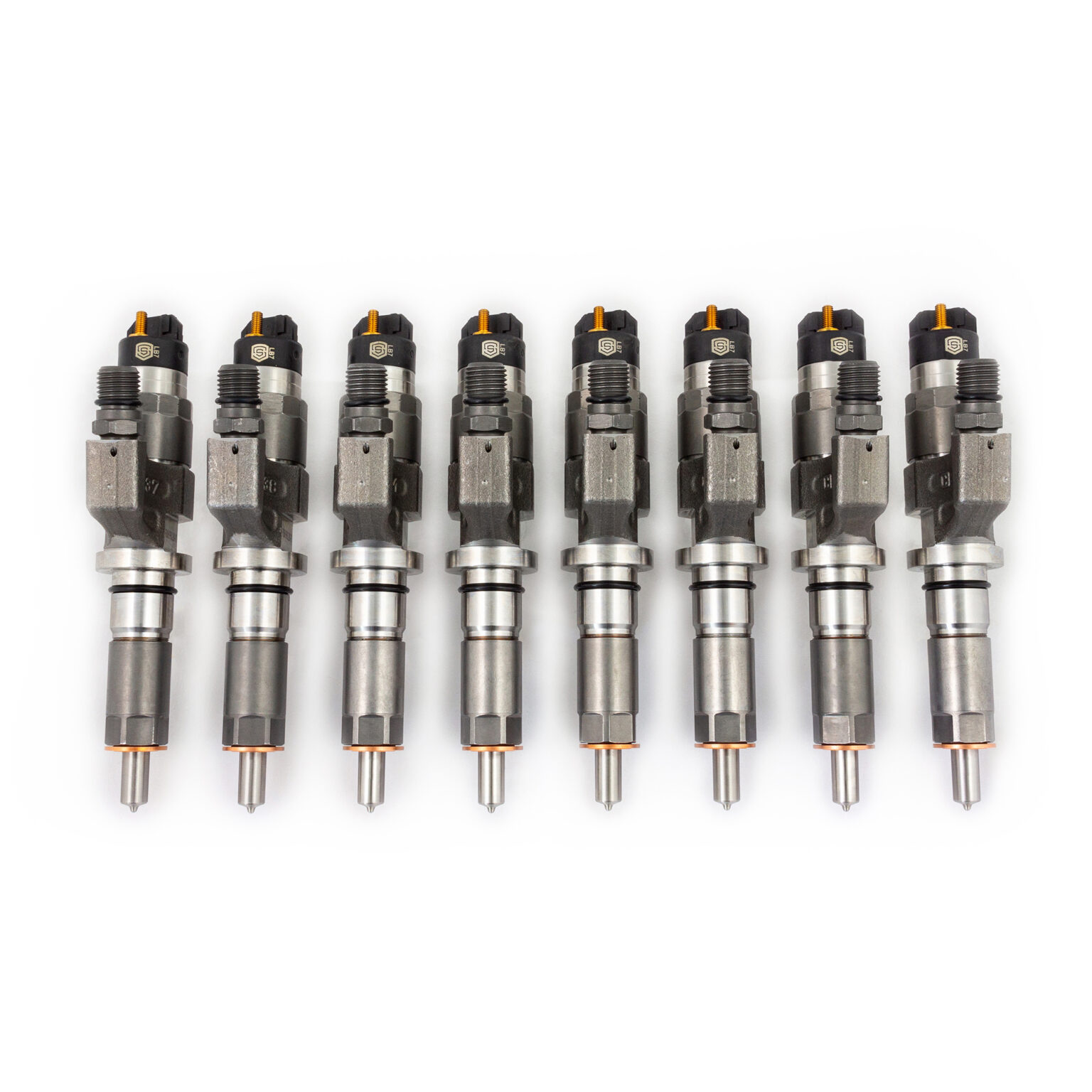
LB7 injector trouble usually shows up as white haze at idle, a hard or no start when the engine is warm, or fuel finding its way into the oil.
The original VCO nozzle is one known durability weakness, but LB7 injector failures can also involve cracked injector bodies, ball-seat erosion, and high-pressure seal problems.
Replacing them means choosing a nozzle type, a size, and whether to buy new or remanufactured.
How Do You Know Your LB7 Injectors Are Going Bad?
Three complaints come up over and over on the 2001 to 2004 LB7, and none of them require a code to be present.
White haze at idle
The truck sits at a stoplight and puts out a light white or gray cloud, often with a strong unburnt fuel smell. It usually clears up under load, which is why people talk themselves out of it.
An injector that leaks more fuel into the cylinder than the ECM asked for is putting fuel in that doesn’t burn hot enough to disappear.
Hard start or no start when warm
Cold start is fine, then the truck sits for twenty minutes and cranks forever. Warm fuel is thinner and flows faster, so an injector with a high internal return rate can send fuel back to the tank about as fast as it comes in.
Worth knowing: this condition is separate from what a balance rate reading shows, and confirming it takes return-flow testing.
Fuel in the oil
Rising oil level, a diesel smell in the oil, or fuel coming out of the crankcase vent. That means fuel is reaching the crankcase.
Injector failure is one cause on an LB7, but other components under the valve covers can leak fuel into the oil as well, so confirm the source before ordering injectors. Either way, stop driving the truck.
If the haze is paired with coolant loss, don’t assume the injectors are responsible.
A coolant-related problem can also produce white exhaust, so confirm what the truck is actually losing before you order parts.
Why Do LB7 Injectors Fail?
The factory LB7 injector uses a VCO nozzle. VCO stands for valve covered orifice. The needle seals on a seat above the spray holes, and there is very little volume below that seat.
S&S describes that original nozzle as a previous-generation design with known durability problems. The SAC-style replacement uses a different nozzle geometry. LB7 injector trouble isn’t limited to nozzle wear, though. Cracked injector bodies, ball-seat erosion, and high-pressure seal failures are also recognized causes of excessive return flow and fuel in the oil.
Exactly why the VCO nozzle wears out is still debated, and there are two leading theories. The first is seat wear. As the VCO seat wears, its contact band widens, sealing force drops, and fuel leaks past the needle. That leak is what causes the haze at idle. The SAC design keeps that band narrow.
The second is cavitation. Because the VCO has very little volume below the seat, fuel has to make a hard turn into the spray holes. That causes cavitation, which erodes the nozzle. This theory comes from Cummins testing, not LB7 testing.
This is a design issue, not a maintenance failure. Whichever theory is right, the proven point is clear: LB7 VCO nozzles wear early and leak, SAC nozzles don’t, and that is why the OEs switched to SAC. SAC nozzles are the OE standard on newer engines.
What’s the Difference Between SAC and VCO Nozzles?
A SAC nozzle has a small volume, the sac, below the needle seat. The needle seals at a seat above the holes, the same as on a VCO nozzle.
| VCO nozzle (factory LB7) | SAC nozzle | |
| Durability | Known durability issues | Increased injector lifespan |
| Status | Obsolete design | OE standard on newer engines |
Every S&S LB7 injector except TorqueMaster uses a SAC-style nozzle. That exception is worth knowing before you order, because TorqueMaster on this platform is a stock-plus option and is not part of the SAC lineup.
What Is a SAC00 Injector?
The problem with SAC nozzles on the LB7 used to be that they only existed in oversized flow rates. If you wanted the better nozzle, you had to accept more fuel than stock and deal with the calibration that comes with it.
S&S worked directly with Bosch to build a SAC nozzle that flows the same as stock. That’s the SAC00, and it’s the reason a stock LB7 owner can get the newer nozzle design without changing anything else about the truck:
- Stock fuel delivery, no calibration required
- CARB compliant under EO D-756-2
- Direct replacement for 2001 to 2004 Duramax pickups
- Exclusive to S&S
If your goal is to fix the truck and keep it stock, that’s the one. Note that the CARB Executive Order applies to the SAC00 specifically, not to the oversized sizes.
What Size LB7 Injectors Do You Need?
The industry sizes injectors by percentage increase in nozzle flow over stock. A 30% over injector flows 30% more than factory. It does not make 30% more power.
S&S offers the LB7 in TorqueMaster, SAC00, SAC45, and 30% through 500% over.
For a stock or lightly modified truck, SAC00 keeps everything where the factory put it. Above that, injector size is one part of a package that includes the pump, the turbo, the supporting fuel system, and the calibration. Larger nozzles slow the injector’s opening and closing, which is why S&S custom-matches the build spec of the injector to the flow rate of the nozzle rather than just installing a bigger tip.
LB7s can run injectors up to 100% over without a new calibration, but smoke increases with nozzle size, especially at full load. SAC45s on a stock calibration will show a little haze, though nothing severe. Only SAC00 or stock VCO injectors have no effect on emissions without a calibration.
Putting a large injector in a truck that can’t support it produces smoke, heat, and drivability problems, not power. If you’re going past stock flow, talk it through with a dealer using your turbo, your power target, and how the truck gets used.
New or Remanufactured?
Both, if they come from the right place. S&S publishes a grading scale for common rail injectors that’s worth understanding before you compare prices:
| Grade | What it is | Warranty |
| A+ | S&S new: OEM-manufactured new injectors, then modified, tested, and supported by S&S | 2 years |
| A | OEM new | 2 years |
| B+ | S&S remanufactured: rebuilt directly by the OEM with mostly new components, then modified, tested, and supported by S&S | 2 years |
| B | OEM remanufactured: rebuilt directly by the OEM with mostly new components | 2 years |
| C | OEM certified reman: rebuilt at an independent facility with OEM-certified processes | 2 years |
| D | New, built from a mix of OEM and independent components at a facility of unknown quality | 0.5 to 5 years |
| E | Reman using a mix of OEM and independent parts at a facility of unknown quality | 0.5 to 7 years |
| F | Refurbished: used injectors cleaned, tested, and balanced | 0 to 2 years |
| G | Used as-is, untested | None |
| Z | OEM knock-offs, identical looking down to the laser etching | None |
That scale explains the price spread you see shopping LB7 injectors. A set at the bottom of the market is not the same product as a set at the top, and on an engine where the labor to get to the injectors is the expensive part of the job, the grade matters more than it would somewhere easier to reach.
S&S LB7 sets run $1,968.00 to $6,562.40 depending on size and whether they’re new or reman. Core returns are required, with a $150 charge if no core comes back.
Should You Replace All Eight?
Generally yes. S&S recommends replacing all eight injectors as a balanced set, and there’s a technical reason beyond “you’re already in there.”
Fuel quantity may be the same from one injector to the next, but injection timing and rate shape can differ slightly. Mixing injectors can cause a rough idle or balance rate issues.
S&S flow-matches nozzles to 1% variance and complete injectors to 3% or less quantity variance across the set, at four different pressure and energizing points, and every injector in the set shares the same rate shape. That balance exists across the eight injectors sold together. Dropping one or four new injectors into an older set gives up the thing you paid for.
Frequently Asked Questions
What causes the white haze at idle on an LB7?
An injector leaking more fuel into the cylinder than commanded. The extra fuel doesn’t burn completely and leaves as white or gray vapor. It’s the most recognized sign of LB7 injector wear.
Will a balance rate test find a bad LB7 injector?
Not on its own. Balance rates can show a cylinder the ECM is compensating for, but that by itself doesn’t prove an injector is bad. Excessive internal return is a separate condition and needs return-flow testing.
What does SAC00 mean?
SAC refers to the nozzle design, and 00 means stock flow. It’s a SAC nozzle that delivers the same fuel as the factory injector, developed by S&S with Bosch for the LB7.
Do SAC00 injectors need a tune?
No. They deliver stock fuel and require no calibration change, which is also why they carry CARB EO D-756-2.
Are S&S remanufactured injectors as good as new?
They start from injectors rebuilt directly by the OEM with mostly new components, then get modified, tested, and balanced by S&S. Both new and reman carry the same two-year warranty.
Not sure which size fits your truck? An S&S dealer can work through your combination with you before you order. Find a dealer.