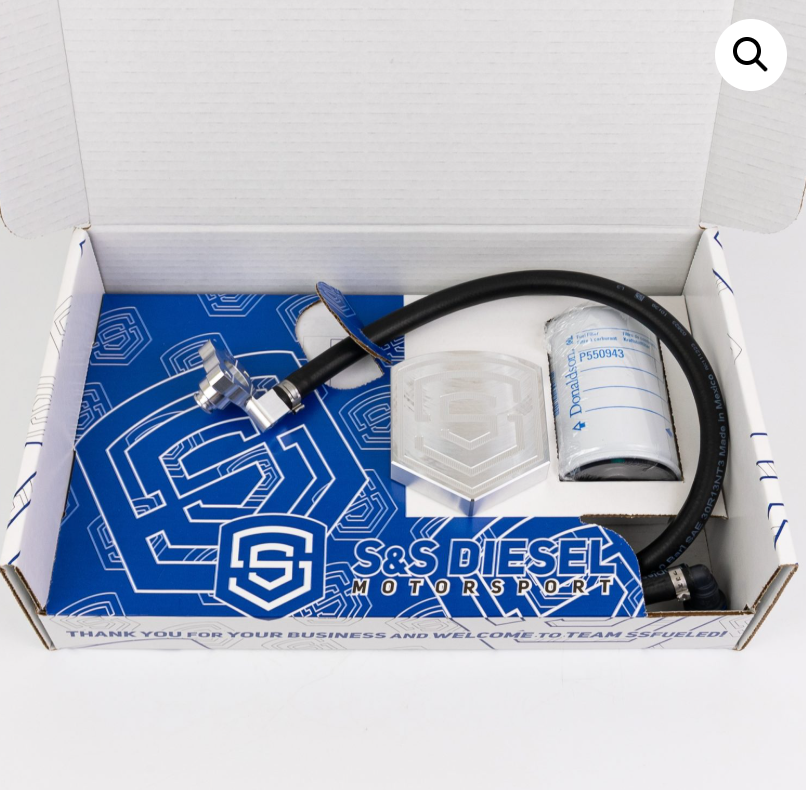
If you own a 6.7L Power Stroke with the factory CP4 high-pressure fuel pump, S&S Diesel Motorsport offers two very different ways to address the risk of a CP4 failure.
The Gen2.1 Disaster Prevention Kit (DPK) keeps the factory CP4 in place but reroutes the fuel system so debris from a failed pump is isolated before it can contaminate the injectors, rails, lines, and fuel tank.
The DCR Pump Conversion takes a different approach. It removes the CP4 completely and replaces it with the S&S and PurePower DCR high-pressure fuel pump.
For most owners, the decision comes down to one question: Do you want to protect the fuel system if the CP4 fails, or replace the CP4 before it has the opportunity to fail?
DPK vs. DCR at a Glance
| S&S Gen2.1 DPK | S&S DCR Conversion | |
| What happens to the CP4? | Remains in the truck | Removed |
| Main purpose | Contains debris if CP4 fails | Removes the CP4-specific failure mode |
| Current S&S price | $400 | $2,400 |
| Calibration required | No | No |
| Fitment | 2011 through 2026 | 2011 through 2026 |
| CARB EO coverage | 2011 through 2023; 2024 and later is fitment only | 2011 through 2023; 2024 and later is fitment only |
| Warranty | Two-year, unlimited-mile | Two-year, unlimited-mile |
| Installation | Less involved | More involved |
| CP4 can still fail? | Yes | CP4 is no longer installed |
| Adds horsepower? | No | No, although DCR has additional fuel capacity |
| Best fit | Lower upfront cost, retain factory pump | Owner who wants to replace CP4 entirely |
What Does the Disaster Prevention Kit Actually Do?
The DPK does not prevent the CP4 itself from failing.
Instead, S&S designed the Gen2.1 system to separate the clean fuel supply from the CP4 case fuel and route potentially contaminated return fuel through its own filter.
The Gen2.1 kit splits the fuel supply approximately 25 inches before the CP4 and uses a dedicated Donaldson return filter to capture debris before it can reach the tank. S&S states that the system safeguards the injectors, rails, lines, and tank from CP4 debris.
S&S has also purposely failed CP4 pumps during testing with the Gen2.1 system installed to validate the design. S&S backs the Gen2.1 DPK with the same two-year, unlimited-mile warranty as the DCR.
The advantage is cost. At $400 for the complete kit, an owner can keep a functioning CP4 rather than replacing a pump that has not failed.
The tradeoff is that the CP4 remains in the truck.
What Does the DCR Conversion Do Differently?
The DCR conversion removes the CP4 entirely.
S&S Diesel Motorsport and PurePower Technologies developed the Ford-specific DCR using a Stanadyne pump architecture and designed it to match the factory CP4 output curve. It installs without requiring an ECU calibration change.
The DCR uses a two-piston design with a pressure-lubricated cam and bushings and patented eccentric drive technology.
It can deliver up to 1,250 mm³ per revolution, which S&S says is approximately 25 percent more displacement than the CP4.2. That additional capacity can support more fuel if the calibration and rest of the fuel system call for it, but simply installing a DCR does not add horsepower.
S&S currently lists the DCR conversion at $2,400 and backs it with a two-year, unlimited-mile warranty.
Is the DCR Better Than a Disaster Prevention Kit?
It depends on what you are trying to accomplish.
If the objective is to spend the least amount of money today while protecting the expensive fuel system from CP4 debris, the DPK makes sense.
If the objective is to remove the CP4 itself, the DCR is the more complete solution.
That distinction is important because calling the DPK a cheaper version of the DCR is inaccurate. They solve the problem differently.
The DPK is damage containment.
The DCR is pump replacement.
Owner discussions around these products tend to revolve around exactly that tradeoff: spend roughly $400 to protect the system while continuing to run the CP4, or spend substantially more upfront and replace the CP4.
Can You Run a DPK With a DCR?
No, and there is no reason to.
S&S states that the Gen2.1 DPK was designed specifically around the CP4 fuel system. Once the CP4 is replaced by the DCR, the DPK is neither compatible nor necessary.
Should You Install a DPK Now and a DCR Later?
That is a legitimate strategy.
An owner with a healthy CP4 may decide to install the DPK now because of the lower upfront cost. If the CP4 eventually needs replacement, that owner could then choose to install the DCR.
Other owners would rather replace the CP4 immediately and avoid paying for both products over time.
Neither approach is inherently wrong. It comes down to budget, how long you intend to keep the truck, how heavily you depend on it, and how much risk you are comfortable accepting.
Which One Should You Choose?
Choose the Gen2.1 Disaster Prevention Kit if your CP4 is currently healthy, you want protection from a contaminated CP4 failure, and the lower upfront cost is important.
Choose the DCR Pump Conversion if you would rather remove the CP4 entirely and address the CP4-specific failure concern at its source.
Both products were developed by S&S Diesel Motorsport for the same underlying concern. They simply attack it from opposite directions.
For owners still unsure which option makes the most sense for their truck, S&S recommends working with an authorized dealer who can evaluate the application and help determine the appropriate solution.
Frequently Asked Questions
Does a Disaster Prevention Kit prevent the CP4 from failing?
No. The S&S Gen2.1 DPK is designed to contain debris if the CP4 fails and protect the rest of the fuel system from contamination.
Does the DCR eliminate CP4 failure?
The DCR eliminates the CP4-specific failure mode because the CP4 is removed from the truck. That does not mean a DCR or any mechanical fuel pump can never fail.
Does a DCR conversion add horsepower?
Not by itself. S&S states that the DCR has approximately 25 percent more displacement than the CP4.2 and can support additional fuel delivery when the calibration calls for it.
Do you need both a DPK and DCR?
No. S&S specifically states that the Gen2.1 DPK is not compatible with and is not needed with the DCR conversion.