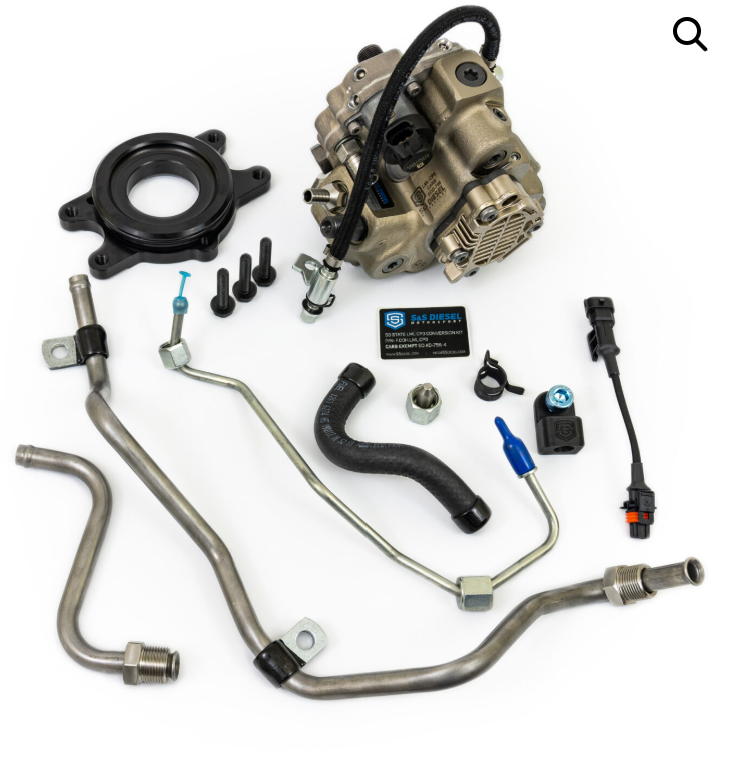
For most 2011 to 2016 LML Duramax owners, this isn’t a power question. It’s a risk question.
Your LML left the factory with a Bosch CP4.2 high-pressure fuel pump. Not every CP4 that gives up does it the ugly way, but when one suffers a catastrophic internal failure it can grind itself apart and push metal downstream at injection pressure. That puts your injectors, rails, and lines in the debris path, along with the return side and the tank, because the metal goes everywhere the fuel goes.
A CP3 conversion takes that pump out and puts a Bosch CP3 in its place. So the real question was never whether a CP3 can run an LML. It can. The question is whether it’s worth pulling a CP4 that’s working fine today.
Why Swap a CP4 That Still Works?
Because a catastrophic CP4 failure can happen without reliable advance warning.
Plenty of LMLs have gone well past 200,000 miles on the original pump, and owners who’ve had that experience will tell you the whole thing is overblown. Owners who’ve written the check after a failure will tell you something different. Both are looking at the same pump.
What a conversion buys you isn’t a guarantee that nothing will ever go wrong with your fuel system. It’s the removal of one specific failure mode, the one that turns a pump problem into a fuel system problem.
If the truck tows, works for a living, or takes you a long way from home, that tends to matter more than it does on a truck that runs to town and back.
What Actually Gets Replaced
The factory CP4.2 comes out, and the fuel system is adapted to run a CP3 in its place.
Worth knowing: on a Duramax this is a direct, gear-driven, in-valley swap. The CP3 mounts where the CP4 lived and is driven the same way. That’s why the conversion is a clean answer on GM trucks and isn’t one on a Ford 6.7L Power Stroke, where the pump won’t fit in the valley and the only way to mount a CP3 is off the front of the engine on a belt.
S&S offers the LML conversion in several configurations:
| S&S LML CP3 option | What it’s for |
| 50-state CP3 conversion | CARB EO D-756-4, keeps the factory emissions equipment, no tuning required |
| No-tuning CP3 conversion | Competition use, no calibration changes required |
| Tuning-required conversion | Competition use, built around appropriate calibration changes |
| Conversion kit without pump | For customers supplying their own compatible pump |
| High-output pump options | S&S SuperSport, 10mm, 12mm, and 14mm CP3s |
Read that table carefully, because two of those rows say “no tuning” and only one of them is street legal. The 50-state kit is the one that carries CARB Executive Order D-756-4. It retains the factory emissions equipment, which is exactly why it qualifies for the EO. The other configurations are competition parts.
Does It Require Tuning?
Not necessarily, and this is where a lot of older advice on forums leads people wrong.
Older forum threads can make it sound like every LML CP3 conversion needs a tune. That is no longer the case. S&S offers both tuning-required and no-tuning-required configurations, and the difference is in the hardware: the no-tune version uses a custom metering unit matched to the CP4 flow curve, while the tuning-required version uses an LBZ-based metering unit that needs a pump-curve revision to go with it. The 50-state conversion runs without calibration changes and leaves the emissions system alone.
That’s the part worth sitting with if you assumed a CP3 swap meant giving up an emissions-intact truck. It doesn’t have to.
What does matter is picking the right version. A conversion designed around a calibration needs to be paired with the pump and the calibration it was designed for. Mixing configurations is how people end up chasing rail pressure problems that were built in on the day of the install.
What It Costs
S&S currently lists LML CP3 conversion options from roughly $800 to $2,600, depending on the configuration and whether a pump is included. The 50-state, no-tune conversion with pump is listed at $2,600.
Labor is on top of that, and it varies by shop. This is not a fifteen-minute pump swap from the top of the engine, so budget accordingly and get a quote rather than assuming.
The number to weigh it against is what a contaminated fuel system costs to put right, which runs into five figures once injectors and rails are in the conversation. That’s the whole calculation: a known cost now against a possible much larger one later.
One thing to be clear about. If your CP4 has already failed, a conversion is still the right destination, but you can’t just bolt a CP3 onto a dirty system and call it done. The contamination has to be dealt with first, or the debris left behind goes to work on the new pump. Converting during that repair makes sense. Converting instead of that repair does not.
Does a CP3 Add Horsepower?
Not by itself, no.
On a stock or near-stock LML, the conversion is a reliability move and you shouldn’t expect a power change from it. A bigger pump doesn’t make power. It supports the fuel demand of the parts that do.
Where pump capacity starts to matter is on a build with the injectors and calibration to use it. That’s what the SuperSport, 10mm, 12mm, and 14mm options exist for, and the right one depends on your injectors, your calibration, and your power target as a package. Picking the pump first and working backward is how people end up with an expensive part that isn’t doing anything.
Related: a new high-pressure pump won’t fix worn injectors. If the truck has a drivability complaint that traces back to the injectors, the conversion isn’t the repair.
Do You Need a Lift Pump?
No. The CP3 has a gear pump built into it that pulls fuel from the tank on its own, so the conversion doesn’t create a requirement for one.
That said, a lift pump isn’t a bad thing to have. It makes troubleshooting easier because it gives you a supply pressure you can actually measure, and higher-horsepower builds benefit from the added supply. It’s just not something the conversion forces on you.
So, Is It Worth It?
If your goal is to get the CP4.2 out of your 2011 to 2016 LML, this is the direct way to do it, and there’s a version that keeps the truck 50-state legal without a tune.
It isn’t a requirement. Trucks are out there with a lot of miles on the original pump and no trouble. What it is, is a decision about how much risk you want to carry and for how long. If you’re keeping the truck, working it, or towing with it, paying a known number now instead of an unknown one later is a reasonable trade. If you’re selling it next spring, maybe less so.
The useful part is that you don’t have to pick between emissions-legal and capable. There’s a configuration for a stock truck that keeps everything intact, and there are configurations for builds that need real fuel volume.
Frequently Asked Questions
What years of Duramax use the LML engine?
The LML was used in 2011 through 2016 Chevrolet and GMC HD diesel trucks.
Can you CP3 swap an LML and keep the emissions equipment?
Yes. The S&S 50-state conversion carries CARB EO D-756-4, retains the factory emissions equipment, and requires no tuning.
Does every LML CP3 conversion require tuning?
No. S&S offers both no-tuning-required and tuning-required versions. The tuning-required and non-50-state versions are competition parts.
Can I run a larger CP3 with the S&S conversion?
Yes. The conversion is available with SuperSport, 10mm, 12mm, and 14mm CP3 options for builds that need the additional fuel delivery.
Do I need a lift pump with an LML CP3 conversion?
No. The CP3 draws fuel from the tank with its own internal gear pump. A lift pump can still be useful for troubleshooting and on higher-horsepower builds, but the conversion doesn’t require one.
My CP4 already failed. Can I just convert?
The conversion is the right end point, but the contaminated fuel system has to be cleaned or replaced first. Debris left in the system will damage the new pump.