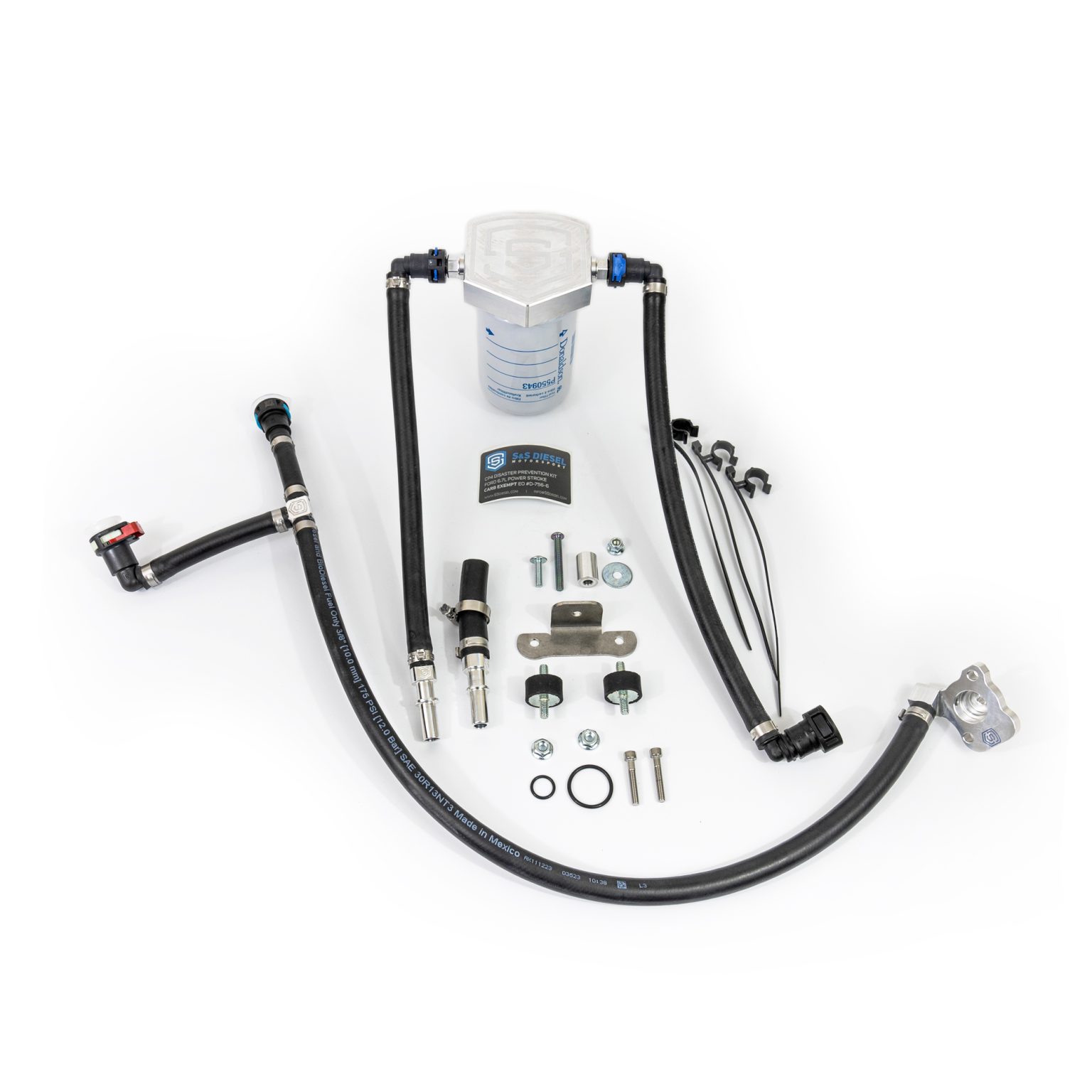
A CP4 disaster prevention kit is a bypass and filtration kit designed to contain the damage when the Bosch CP4.2 high-pressure fuel pump in a 2011 to 2025 6.7L Power Stroke fails. It cannot stop the pump itself from failing, but it is designed to keep metal debris out of the injectors, fuel rails, lines, and tank. This can help prevent a failed CP4 from turning into a complete fuel-system replacement.
S&S Diesel Motorsport built the first one in 2016. It’s been copied plenty since. Here’s what it actually does, what it doesn’t do, and how to decide if your truck needs one.
Quick Facts
| Fits | 2011 to 2025 Ford Super Duty trucks with the 6.7L Power Stroke. A separate kit is available for F-650 applications. |
| Price | $400 full kit (#CP4-6.7F-BP-G2.1) |
| Emissions | CARB EO D-756-6 , legal in all 50 states |
| Install | DIY with hand tools, about half a day |
| Return filter | Standard Donaldson P550943 spin-on, 9-micron at 99% efficiency, available at most parts stores |
| Made in | USA |
Why Do CP4 Pumps Fail?
The CP4.2 is the high-pressure fuel pump Ford has bolted to every 6.7L Power Stroke since 2011. It builds injection pressure up to around 30,000 psi, using two pumping plungers driven by roller lifters riding on a camshaft.
One of the CP4’s known failure modes begins at the roller and cam interface. Under the wrong conditions, it can rotate sideways on the cam lobe. Instead of rolling, it skates, and now you’ve got two hardened steel parts grinding each other into glitter. US diesel fuel doesn’t help; it’s a low-lubricity fuel, and the CP4 was originally designed around European diesel with more lubricity built in. The pump runs on a thinner margin here than it was designed for.
Here’s the ugly part: the pump usually gives you no warning. It’ll build pressure and run the truck fine while it’s eating itself, and the whole time it’s pushing that metal debris downstream at injection pressure and circulating it back through the return system. By the time you get a hard start, a crank-no-start, or a rail pressure code, the debris has already toured the entire fuel system.
What Does a CP4 Failure Cost Without Protection?
Everywhere the fuel goes, the metal goes. That means all eight injectors, both fuel rails, the high-pressure lines, the low-pressure system, and the tank. The accepted fix , and what Ford’s own service procedure calls for, is replacing the entire fuel system essentially, because there’s no reliable way to guarantee you’ve flushed every particle out of components with passages measured in microns.
Dealer bills for that job routinely land between $8,000 and $12,000. Out of warranty, that’s your money. In warranty, be ready for a fight; fuel contamination claims get scrutinized hard, and plenty of owners have been denied over fuel quality.
The math on prevention isn’t close: $400 once, versus a five-figure bill on the day the pump decides it’s done.
What Does a Disaster Prevention Kit Actually Do?
Two jobs: feed the pump clean fuel, and trap the debris when it fails.
In the stock configuration, the CP4’s internals all share fuel paths, so when the pump starts making metal, that contamination has a route to everything. The S&S kit changes the plumbing. A billet bypass block installs at the fuel control actuator on top of the pump and blocks the internal feed path. The pumping elements and the pump case each get their own independent supply of clean, filtered fuel, with the supply split into two separate lines 25 inches upstream of the pump, far enough that contaminated case fuel can’t back-feed into the clean side even during a heavy failure.
Then everything leaving the pump case gets routed through a dedicated return filter, a billet filter head running a standard Donaldson 9-micron spin-on, before it can reach your tank, lines, or supply pump. When the CP4 lets go, the glitter ends up in a $15 filter instead of your $6,000 injector set.
Two side benefits worth knowing: bench data shows the bypass routing actually improves CP4 output above 3,000 RPM, and because the clean side stays clean, the kit can extend how far a truck will drive during an active failure. That’s the difference between limping home and calling a rollback.
Does It Actually Work?
Fair question, because “snake oil” gets thrown around in the diesel aftermarket for good reason.
S&S is a company founded by OE fuel injection engineers, and they tested this the way an OE would: they purposely failed CP4 pumps on the fuel lab bench and on their own in-house development trucks, with the kit installed, then tore the systems down and inspected. In every test, no metal was found in the high-pressure system. They’ve published the failure-test videos, so you can watch a CP4 die with the kit on and see where the debris ends up.
That’s the standard to hold any kit to: not renderings and marketing copy, but a deliberately destroyed pump and a clean teardown afterward.
What a DPK Won’t Do
Straight talk: the kit does not prevent the CP4 from failing. The pump’s failure mode is internal to the pump, and no external kit changes that. What changes is the blast radius. Without the kit, a dead CP4 takes the fuel system with it. With the kit installed, the goal is to contain the debris so the repair can remain focused on the failed pump and return filter instead of the entire fuel system.
If you want the failure point gone entirely, that’s not a kit , that’s a pump replacement, which brings us to your options.
DPK vs. DCR Conversion
There are two ways to deal with the CP4 in a Ford 6.7L, at two price points:
| Option | What it does | Ballpark cost | Best for |
| Disaster prevention kit | Keeps the stock CP4, contains the failure | $400 | Stock or lightly modified trucks; daily drivers and tow rigs; anyone who wants insurance without touching the factory pump |
| DCR pump conversion | Replaces the CP4 with a Stanadyne DCR pump co-developed for the Ford application by S&S and PurePower Technologies. | ~$2,400 | Owners who want the problem permanently solved, higher-mileage trucks, anyone already deep in the fuel system |
There’s no wrong answer here, just different budgets and risk tolerances. A $400 kit on a stock truck is the best dollar-for-dollar protection in diesel. A DCR conversion is the sleep-at-night permanent fix.
Why Isn’t a CP3 Conversion an Option on the Ford 6.7?
This question comes up constantly, and it’s a reasonable one. The Bosch CP3 is the pump that earned its reputation the hard way: gear-driven, forgiving of low-lubricity fuel, and about as durable as anything in diesel. We love the CP3. We build CP3-based fuel systems for other platforms every day.
It doesn’t work on the Ford 6.7L, and the reason is packaging. The CP3 will not fit in the Power Stroke valley where the CP4 lives. There is no direct swap available. The only way to physically put a CP3 on a 6.7L Power Stroke is to mount it off the front of the engine and drive it with a belt.
That’s where we part ways with it. Belt-driving the only high-pressure pump on the engine means the truck’s ability to run at all now depends on a belt. If that belt breaks, or a tensioner lets go, the engine shuts down. No warning, no limp mode, wherever you happen to be. On a tow rig that’s not a maintenance item, it’s a roadside failure with a trailer attached.
That view comes from our OE engineering background. An OE would not put an engine-critical component on a belt drive, and the added complexity around belt tension, oil supply, and keeping the factory vacuum pump working doesn’t get cleaner the deeper you look. A belt-drive single-pump CP3 trades a known failure mode for a different one, and we don’t think that’s a trade worth making.
For the Ford 6.7L, the DPK and the DCR conversion are the two options we offer, and the two we stand behind.
Full explanation here: Why a CP3 conversion doesn’t work on the 6.7L Power Stroke (video)
What About LML Duramax and Ram Trucks?
Ford isn’t the only one with a CP4 story. The 2011–2016 LML Duramax runs the same CP4.2, and 2019–2020 Ram 6.7L Cummins trucks got a CP4.5 that went so poorly it triggered a recall. This particular kit is Ford-only , for the GM and Ram platforms, the fix is a CP3 conversion that removes the CP4-family pump entirely. On those engines the CP3 is a gear-driven, in-valley swap, which is what makes it the right answer there and the wrong one on the Ford. S&S makes a 50-state-legal LML CP3 conversion and a 2019–2020 Ram CP3 conversion for exactly that.
Is a Disaster Prevention Kit Emissions Legal?
Yes , the S&S Gen2.1 kit carries CARB Executive Order D-756-6, which makes it legal in all 50 states, California included. The CARB Executive Order confirms that the kit is approved for use on the listed applications under California emissions requirements. Not every kit on the market can say that. Check for the EO number before you buy anything in this category.
Can You Install It Yourself?
Yes, and thousands of owners have. It’s hand tools and a careful half-day: the intake comes off to reach the pump, the bypass block and filter assembly go on, and everything connects with OE-style quick connects, no cutting the factory supply line, no compression fittings, no threaded joints to weep. One part number fits 2011–2025, with a couple of extra steps on 2020+ trucks covered in the instructions.
The one rule that matters more than any torque spec: cleanliness. Common rail systems are killed by debris, so you blow out every component with compressed air before it goes in and you never let anything fall into the pump inlet. The written instructions and install video walk through the whole job, including the model-year differences.
After that, maintenance is one item: change the return filter on the same schedule as your other fuel filters , Ford calls for every third oil change or 22,500 miles under normal duty. It’s a standard spin-on you can grab at the parts store.
FAQ
Will a disaster prevention kit stop my CP4 from failing?
No. It contains the failure. The pump can still die, but the debris gets trapped in the return filter instead of destroying your injectors, rails, lines, and tank.
How do I know if my CP4 failed after the kit is installed?
Cut open the return filter and inspect the media. Metal in the filter means the pump is failing or failed , and it also means the kit did its job.
Is a “CP4 bypass kit” or “fail-safe kit” the same thing as a disaster prevention kit?
Yes. Different names, same category of product. S&S coined “Disaster Prevention Kit” when they released the original in 2016, and the industry uses the terms interchangeably.
What’s different about the Gen2.1 kit?
Three main things over the original: all OE-style quick connects (no cutting the factory supply line, which was a debris and leak risk), the supply split moved 25 inches from the pump to prevent back-feeding during a failure, and a billet return filter head that takes a cheap, standard Donaldson spin-on instead of a proprietary filter.
Will it void my Ford warranty?
An aftermarket part doesn’t automatically void a warranty , under federal law (Magnuson-Moss), a dealer has to show the part caused the specific failure to deny a claim. A CARB-certified fuel filtration kit is about as defensible as bolt-ons get. That said, warranty outcomes come down to your dealer, so know where yours stands.
How often does the return filter need changing?
Same interval as your other fuel filters , every third oil change or 22,500 miles under normal conditions per Ford’s schedule, sooner under severe duty. Replacement is a standard Donaldson P550943.
The S&S Gen2.1 6.7L Power Stroke CP4 Disaster Prevention Kit is designed, machined, and tested in the USA by the fuel-injection engineers who created the original in 2016. See the kit, failure-test videos, and current pricing here.